Sell My Bugatti Chiron: A Discreet Acquisition Protocol
The decision to sell your Bugatti Chiron requires more than a listing; it calls for absolute clarity, technical accuracy, and a buyer with immediate liquidity. Exotics Wanted operates as a professional acquisition partner, working directly with private owners to navigate the Bugatti Chiron resale value 2026 with precision and security.
Documentation, secure certified payment, and nationwide enclosed transport are handled on your behalf, allowing the process to remain clear and stress-free from start to finish.
After an intense, multi-year development and testing program, the first exclusive units of the Chiron Super Sport are entering customers’ hands 2021 Monterey
How It works
Tell Us About Your Exotic
Start with the year, make, model, and mileage — or enter your VIN to auto-fill.
Upload a few photos if you have them — they help us make a stronger, faster offer.
Get a Real Offer — Fast
No bots. No guesswork. A real buyer reviews your car and sends a firm cash offer — usually within 1 business day.
Accept & Schedule Pickup
No drop-offs, no dealership visits. Wherever you are, we'll schedule nationwide pickup at your convenience.
Get Paid — Typically Within 24 Hours
Once the title clears, we release your funds — often the same or next day by wire.
Simple. Secure. Fast.
Bugatti Chiron Sport at Jedda, Saudi Arabia
The Model
The Bugatti Chiron
The Bugatti Chiron is an 8.0-liter quad-turbocharged W16 grand tourer producing 1,479 hp and 1,180 lb-ft of torque, with a 0 to 60 time of 2.4 seconds and a production-limited top speed of 261 mph (420 km/h) unlocked only with the factory Speed Key. Built at Bugatti’s Château Saint Jean atelier in Molsheim, Alsace, where each car required approximately nine months of hand-assembly across 1,800 production steps, the Chiron was produced in exactly 500 units between 2016 and 2024 at a base MSRP of $2.998 million before options that routinely pushed delivered prices past $3.5 million. Every unit was spoken for before the 2016 Geneva Motor Show floor closed. Production ended in May 2024 with the delivery of “L’Ultime,” placing every surviving example permanently on the pre-owned market.
The Chiron occupies a unique position in the hypercar segment: it is not a track weapon designed for circuit use, nor a street-legal race car requiring professional acclimatization. It is a genuine intercontinental GT capable of crossing continents at speed in the same comfort as a Bentley Continental, one that holds a 490.484 km/h land speed record verified by German TÜV. Nothing built since occupies the same intersection of luxury, performance, and mechanical complexity, and nothing built afterward, including Bugatti’s own Tourbillon successor, will ever again use a W16 engine in production form.
We actively purchase well-presented examples of the Bugatti Chiron from private owners nationwide. Vehicles are reviewed individually, with attention to condition, specification, history, and overall presentation rather than a fixed checklist.
If your vehicle differs in mileage, configuration, or ownership history, it can still be reviewed. Each submission is evaluated on its own merits, without requiring it to fit a predefined profile.
Bugatti Chiron (W16, 2016–2019):Sovereign Icon One of approximately 300 examples built to base specification in the only production run of the W16 platform. Valuation is strictly governed by service record completeness, fuel tank replacement documentation, Speed Key presence, and unmodified factory specification. Any gap in the provenance chain creates immediate discount exposure on a car where condition differentials drive six-figure swings.
Bugatti Chiron Sport (W16, 2019–2020):Sovereign Icon Approximately 60 examples, 18 kg lighter than the base car with Dynamic Torque Vectoring standard, revised suspension calibration, and carbon fiber structural crossmembers replacing aluminum. Among the rarest production variants from a standard-configuration standpoint, with unique structural elements that cannot be retrofitted to base Chiron specification.
Bugatti Chiron Pur Sport (W16, 2020–2021):Sovereign Icon 60 units globally with a purpose-built mechanical specification that has no equivalent elsewhere in the Chiron lineup: fixed carbon rear wing generating 90% more rear downforce, bespoke Michelin Pilot Sport Cup 2R TR tires at $42,000 per set, re-geared Ricardo DCT with 15% shorter ratios, and 50 kg weight reduction via 3D-printed titanium exhaust and magnesium wheels. Valuation consistently tracks above original MSRP at auction with a 100% sell-through rate. Documentation of NHTSA Recall 21V-984 tire compliance is mandatory for clean transfer.
Bugatti Chiron Super Sport (W16, 2021–2024):Sovereign Icon Approximately 50 standard Super Sport examples producing 1,578 hp with extended rear coachwork (250mm longtail) and 440 km/h capability. The most powerful and fastest variant available to collectors outside the 300+. Sur Mesure commissions within this variant, including documented one-of-one specifications such as the “Golden Era” and “Éléphant Blanc,” command premiums commensurate with the uniqueness of the commission and the completeness of La Maison design records.
Bugatti Chiron Super Sport 300+ (W16, 2021–2022):Sovereign Icon 30 units globally commemorating the 490.484 km/h land speed record, 8 allocated to the United States. The apex Chiron variant and the most investment-credible configuration in the lineup. Auction results trace an unambiguous appreciation curve from the first public sales through the confirmed record of $5,725,000 at Bonhams Audrain in October 2025. Valuation is entirely governed by documentation completeness, unmodified factory condition, and the integrity of the titanium exhaust and speed-record heritage specification.
The Chiron Pur Sport on the Pflanzgarten at the Nürburgring Nordschleife.
Bugatti Chiron special editions (Noire, 110 Ans, Les Légendes du Ciel) and one-off commissions (Profilée, Hermès editions) are evaluated individually outside the standard variant framework. If you hold one of these vehicles, speak with an advisor for a bespoke assessment.
The Sophisticated Exit
Bugatti Chiron: The Secondary Market Intelligence Report
The Bugatti Chiron completed its 500-unit production run in May 2024, ending the W16 engine program permanently after approximately 950 road cars across two platforms. With 140 to 160 units allocated to North America and only 10 to 15 actively listed at any time, the US secondary market is thin, closed-loop, and sharply divided by variant.
The 500th car, a bespoke Super Sport christened “L’Ultime,” left the Molsheim atelier and closed a chapter no future Bugatti will reopen. The W16, an 8.0-liter quad-turbocharged engine producing 1,479 hp in base form and 1,578 hp in Super Sport trim, will never be manufactured again. The Tourbillon, Bugatti’s successor limited to 250 units at a base price above $4.1 million, replaces the W16 with a Cosworth-developed naturally aspirated 8.3-liter V16 paired with three electric motors. The two engines share a brand. They share nothing else.
Nine Months Per Car, 1,800 Steps, Zero Shortcuts
What the production numbers do not convey is how each of those 500 cars was built. Every Chiron required approximately nine months of hand-assembly across 1,800 individual production steps at Bugatti’s Château Saint Jean atelier in Molsheim, Alsace. The exposed carbon fiber bodywork that commands $200,000 to $315,000 as a factory option is not a paint process; it is a manufacturing discipline in which each panel’s weave must align perfectly with every adjacent panel across the entire body, with zero visible imperfections in the material. Sur Mesure commissions pushed further: the paint process alone can exceed 600 hours, with specifications drawn from a palette of 23 topcoat colors, 8 carbon variants, 31 leather hides, and 30 stitching options before bespoke requests even begin. The Chiron was not configured on a screen and assembled by robots. It was composed at a workbench in a converted château by specialists whose output was measured in months per car, not cars per month. That manufacturing reality is part of what collectors are pricing when they separate a Sur Mesure Super Sport from a standard-specification base model at auction.
Sur Mesure at Its Extreme: The “Golden Era” Commission
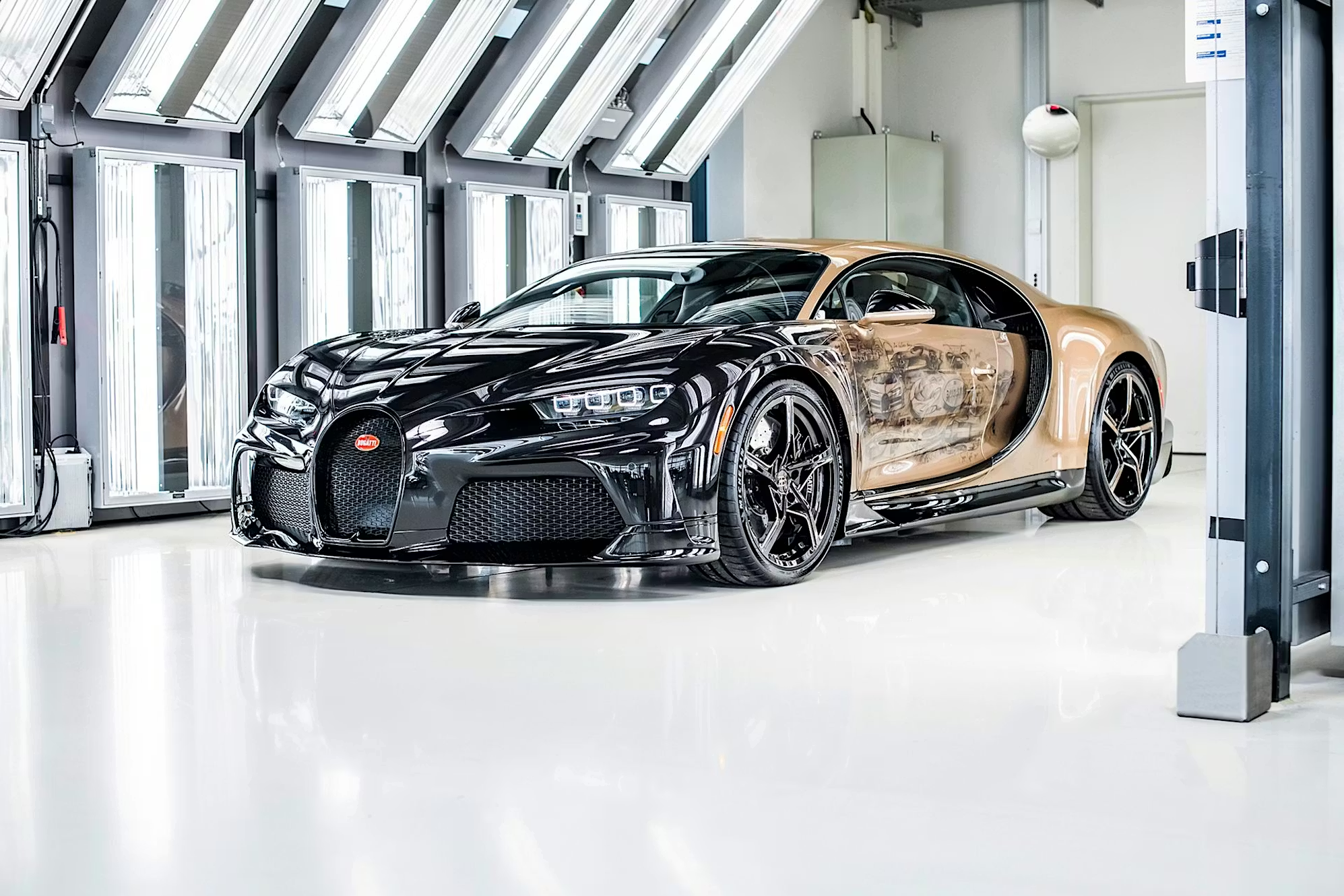
The Chiron Super Sport “Golden Era,” delivered at Monterey Car Week after a two-year collaborative creation process, illustrates the ceiling: 45 hand-drawn sketches depicting 115 years of Bugatti history applied directly to the body in a technique developed over three months of experimentation, with each panel sanded, sketched, and clear-coated up to four separate times to achieve three-dimensional depth that no decal, foil, or wrap could replicate. An entirely new shade of “Doré” gold was developed for the base, fading by hand into Nocturne Black. The interior extends the artistry onto curved leather door panels, with illustrations painted flat and stretched to fit, a process requiring the craftspeople to predict and account for curvature before the leather was installed. This is not customization. It is commission-grade applied art on a car engineered to be driven at 273 mph, and it is the standard against which every Sur Mesure Chiron’s provenance is measured. The car carries its origin in its surfaces.
The Chiron Super Sport ‘Golden Era’ is the very embodiment of Bugatti’s peerless Sur Mesure program.
Every surviving Chiron now exists exclusively on the secondary market. Approximately 140 to 160 of the 500 units were allocated to North America, making the United States the deepest Chiron market globally. At any given time, roughly 10 to 15 unique Chirons appear listed for sale across US platforms, representing just 3 to 5% of the estimated domestic fleet. The remaining 350 to 400 units sit in long-term private collections across the Middle East, Europe, and Asia. Many will not resurface for years. Some will never trade again.
For a seller holding a Chiron in 2026, the question is not whether the car has value. The question is which Chiron you own, because the market has split into two fundamentally different assets wearing the same badge.
The Two-Tier Market: Variant Is the Only Variable That Matters
The Chiron secondary market has split into two distinct tiers: base models carrying a 44% auction sell-through rate with persistent no-sales at major houses, and limited variants (Pur Sport, Super Sport, Super Sport 300+) achieving 88 to 100% sell-through with confirmed appreciation above MSRP. The variant printed on the build sheet, not the option spend, determines which tier a seller occupies.
The Chiron platform encompasses five core performance tiers (base, Sport, Pur Sport, Super Sport, Super Sport 300+), four named limited editions (110 Ans, Noire, Les Légendes du Ciel, L’Ébé), multiple one-offs including the Profilée and Hermès collaborations, and four coachbuilt derivatives (Divo, La Voiture Noire, Centodieci, Bolide). All 500 Chiron-family units plus 91 coachbuilt derivatives total approximately 591 Chiron-platform cars in existence.
The problem for sellers begins with how the market classifies them. Cars.com lists Chiron trims by cosmetic option (“Exposed Carbon Fiber”) rather than actual variant name. A buyer searching online cannot distinguish a $3.6 million Pur Sport from a base Chiron at the lower end of the range. That confusion compresses the perceived value of every limited variant toward the base model floor and forces premium sellers to fight an information deficit before the first phone call.
Base Chiron: Structural Buyer Resistance
The base Chiron, produced in approximately 300 units at an original MSRP near $3 million, carries a documented auction sell-through rate of 44% across nine lots offered between January 2024 and February 2026. More than half of all base Chirons offered at major auction houses failed to find a buyer at reserve. Multiple examples went unsold at RM Sotheby’s Paris (January 2024), RM Sotheby’s Miami (March 2024), Bonhams Miami (May 2024), Barrett-Jackson Scottsdale (Fall 2024), and Broad Arrow Monterey (August 2025).
When base models do clear, they land near or slightly below original MSRP. A Barrett-Jackson no-reserve result at $2,970,000 in January 2024 and a Bring a Trailer sale at $2,850,000 in May 2025 (the former Canelo Álvarez car, which had already failed at a prior auction) establish the realistic clearing zone. Dealer asking prices run significantly higher, but the gap between ask and hammer consistently measures 12 to 25% on standard-specification base cars.
Limited Variants: Appreciation in Motion
The Pur Sport (60 units globally, approximately 10 allocated to the US) has achieved a 100% sell-through rate at every tracked auction appearance. The BaT sale in May 2024 at $4,100,000 was that platform’s highest single transaction of the year. Against a $3.6 million MSRP, this represents 5 to 14% appreciation above sticker, and the trajectory is firm.
The Super Sport and Super Sport 300+ have cleared at an 88% sell-through rate across eight lots, with only one failure: a standard Super Sport at Mecum in January 2026 where bidding stalled at $4.1 million below an aspirational reserve. The one-of-one “Éléphant Blanc” Super Sport sold at Bonhams Scottsdale in January 2026 for $5,065,000. At RM Sotheby’s Zurich in October 2025, a standard Super Sport reached CHF 4,055,000 (approximately $4.5 million).
The Super Sport 300+ sits at the apex. Only 30 units were produced, 8 allocated to the United States. This is the only production car in history with a TÜV-certified speed exceeding 300 mph: Andy Wallace, 304.773 mph, Ehra-Lessien, August 2, 2019. The confirmed auction record stands at $5,725,000 (Bonhams Audrain, October 2025), representing approximately 39% appreciation above original pricing. At that production volume in the world’s most active hypercar market, even a handful of simultaneous buyers can move pricing meaningfully.
The structural driver behind this split is supply arithmetic. Approximately 300 base Chirons exist versus 30 to 60 for the limited variants. In a market where the UHNW buyer pool numbers 510,810 individuals globally (Altrata World Ultra Wealth Report, mid-2025) and is projected to grow 31% by 2030, a 30-unit production run creates a seller’s market. A 300-unit production run does not.
The Depreciation Curve and the Veyron Precedent
The base Chiron’s depreciation position mirrors the Bugatti Veyron at years 7 to 8, when values bottomed at approximately 50% of MSRP before recovering to original list price over the following decade. With first Chiron deliveries dating to March 2017, the base model sits squarely in the historical trough zone. Limited variants have already exited it.
Hagerty’s senior data scientist documented that the Veyron “dipped to around half of its MSRP in years seven and eight, but after 10-plus years on the market it has appreciated to roughly its original list price.” Veyron values bottomed during 2011 to 2013, then climbed steadily. Today, standard Veyrons trade above $2 million, with the Grand Sport Vitesse reaching $2.64 million at Mecum in May 2025 and the one-of-one Grand Sport Sang Bleu selling for $3,085,000 at RM Sotheby’s Miami in March 2024.
When the Chiron was announced at the 2016 Geneva Motor Show, Veyron values did not decline. They accelerated. Classic Analytics managing director Frank Wilke confirmed: “Since the appearance of the new Chiron in 2016 there has been a significant price boost.” The Tourbillon’s arrival should function the same way. Its fundamentally different architecture (naturally aspirated V16 hybrid versus quad-turbocharged W16) makes the Chiron irreplaceable rather than obsolete. Mate Rimac himself framed the dynamic at the 2024 FT Future of the Car conference, comparing ICE hypercars to mechanical watches: “An Apple Watch can do everything better…but nobody would pay $200,000 for an Apple Watch.”
The Tourbillon is completely sold out through 2029, with at least 60 additional customers on a waitlist beyond the 250-unit run. No evidence indicates a Chiron trade-in wave tied to Tourbillon allocations. Most allocation holders are existing Bugatti clients adding to collections, not replacing. The “last W16” heritage premium has begun crystallizing but has not yet fully materialized. The base model’s recovery timeline extends to approximately 2028 to 2032, consistent with the Veyron’s cycle. Limited variants are already ahead of that curve.
The Carrying Cost Reality
The Bugatti Chiron’s annual holding cost runs $70,000 to $120,000 for a collector driving under 500 miles per year, comprising specialty insurance ($30,000 to $60,000), Bugatti-mandated maintenance ($11,500 to $34,000 per service cycle), climate-controlled storage ($12,000 to $24,000), and state registration fees that range from $155 in Florida to $19,500+ in California. None of it is optional.
Insurance requires specialty or collector carriers. Standard insurers cap coverage at approximately $1 million, structurally inadequate for this asset. Agreed-value collector policies through Hagerty, Chubb, or AIG Private Client run approximately 1 to 2% of insured value annually. Specialty premiums have surged 18 to 22% year-over-year across the exotic segment, compounding the carrying burden for long-term holders.
Maintenance follows a schedule unlike any other production vehicle. The annual service (70-point inspection, oil and filter change across 16 drain plugs requiring rear tire removal and brake disassembly, brake fluid, full diagnostic scan) costs $11,500 post-warranty. The four-year Major service adds gearbox oil, drive belts, spark plugs, hydraulic oil, full coolant replacement, and engine air filters across approximately 72 hours of workshop time: $34,000. The fuel tank, constructed of vulcanized rubber with reinforced Kevlar layers, requires scheduled replacement every 42 to 48 months at $42,000 to $44,000. This is a time-based replacement, not mileage-triggered. A Chiron stored in climate-controlled conditions for four years still needs this work. Intercooler replacement runs $19,800 to $22,000 on a similar cycle.
Catastrophic component exposure defines the risk envelope. The W16 engine carries a documented replacement cost of $856,407. The Ricardo 7-speed dual-clutch gearbox: $185,000. Full brake system (carbon silicon carbide rotors, titanium calipers, all four corners): $40,000 to $50,000. Windshield: $54,000. No catastrophic W16 engine failures under normal use appear in public records, owner forums, or NHTSA filings. The Hamilton Collection documented approximately $100,000 in cumulative basic maintenance over a decade with no major mechanical failures. But the financial exposure when a failure occurs is extraordinary, and no aftermarket W16 ecosystem exists. With only 500 units produced, one is unlikely to develop.
Registration costs vary dramatically by state. Florida charges $155 annually. California’s Vehicle License Fee runs 0.65% of vehicle value: approximately $19,500 in year one. Washington State, effective January 1, 2026 under ESSB 5801, imposes an 8% luxury motor vehicle tax on all amounts exceeding $100,000, applied on top of standard sales tax. On a Chiron purchased in greater Seattle, the combined tax burden can exceed $540,000.
At $70,000 to $120,000 annually in carrying costs, a Chiron requires approximately 2.3 to 4% annual appreciation just to break even. Limited variants are clearing that threshold. Base models, at current auction clearing prices, are not.
The W16 and the Silicon Scarcity Threshold
The Chiron’s semiconductor risk profile scores 27 out of 60 on the Silicon Scarcity Asset Matrix, classified as Complex with Protected Dependency. The lowest dimensions, Supply Priority (2/10) and Repair Sovereignty (4/10), reflect Bugatti’s near-total control over the parts pipeline and the absence of any independent W16 service ecosystem.
Diagnostic access requires the factory-level ODIS system through a VAS 6154A interface, and Bugatti has demonstrated willingness to blacklist VINs from the global parts supply chain entirely. With only 500 units produced, no aftermarket service infrastructure is likely to form.
The Engineering That Explains the Score
The engineering that drives that score is worth understanding because it explains both why the W16 commands collector reverence and why independent service is structurally impossible. The engine’s thermal management alone requires 10 radiators circulating approximately 800 liters of coolant per minute to reject the heat generated by four turbochargers compressing intake air across four cylinder banks. A routine oil change accesses 16 separate drain plugs, requiring removal of the rear tires, brake assemblies, fender linings, and underbody panels to reach them. The carbon fiber monocoque that underpins the entire structure delivers 50,000 Nm per degree of torsional stiffness. The drivetrain-to-chassis mating process, what Bugatti internally calls the “marriage,” secures the W16 and Ricardo DCT to the monocoque through a sequence of titanium fasteners whose torque specifications are not published outside Molsheim. This is not a vehicle that tolerates approximation. Every service event requires tooling, training, and parts access that begin and end with Bugatti. The complexity that makes the W16 irreplaceable as a collector asset is the same complexity that makes it impossible to service outside the factory network.
The Analog Advantage Over the Tourbillon’s Architecture
This profile stands in direct contrast to the Tourbillon’s architecture. The successor’s hybrid powertrain, three electric motors, and Cosworth-managed ECU infrastructure introduce an entirely different semiconductor dependency layer, one tied to advanced node fabrication and software-defined vehicle management systems that will face their own supply chain pressures as foundry capacity tightens. The Chiron’s W16, built on mature fabrication nodes with a parts inventory that was fully manufactured before production ended, carries no forward-looking semiconductor exposure. Every component that will ever exist for the Chiron already exists. The question is not supply risk on new production. It is access to existing inventory, and that access runs exclusively through Molsheim.
For a seller, this means the Chiron’s long-term value proposition is insulated from the semiconductor supply dynamics that are compressing values on digitally complex modern exotics. The Analog Premium that protects cars like the Ferrari F355 and Lamborghini Aventador SVJ operates at its most extreme on the W16 platform: a powertrain so mechanically singular that no future technology constraint can render it obsolete, because no future technology will attempt to replicate it.
What the Documentation Package Is Worth
The Chiron’s documentation architecture creates six-figure valuation differences between otherwise comparable cars. Service record completeness, fuel tank replacement receipts, Speed Key presence, Schedoni luggage provenance, and NHTSA recall closure documentation are the five elements that separate full-market outcomes from discounted transactions at this asset level.
Service records are the single most important element. A complete, chronologically organized history from authorized Bugatti partners signals responsible stewardship. A gap raises immediate questions about which expensive lifecycle items were deferred. Given that annual service costs $11,500 and the Major service costs $34,000 across 72 hours of work, a Chiron with documented completion of every scheduled interval commands a meaningful premium over one with unexplained gaps.
The fuel tank service receipt is specific to the Chiron and overlooked more frequently than any other document. Because the tank replacement at $42,000 to $44,000 is virtually unheard of in any other production vehicle, many sellers do not realize it will be one of the first questions a knowledgeable buyer asks. Its absence is a deduction item. Its presence signals that the seller understands the asset at the level the buyer expects.
Speed Key presence matters beyond its replacement cost of approximately $14,000. The Speed Key unlocks Top Speed Mode: ride height drops from 125mm to 65mm, the rear wing adjusts to 2 degrees, diffuser flaps close, and the full performance envelope opens. A missing Speed Key signals negligence and triggers buyer scrutiny disproportionate to the replacement expense.
The Schedoni luggage set, handcrafted from over 150 pieces of leather matched to the car’s interior specification, requires 110 hours to produce. It cannot be recreated for a specific car after the fact. Its absence is immediately noticed by collectors who understand what the car shipped with from Molsheim.
Recall completion documentation closes a gap buyers find within minutes. At least eight distinct NHTSA recall campaigns have affected Chiron-family vehicles in the US, including the 156-unit seatbelt chime recall (24V-096), the Pur Sport rear tire cracking recall (21V-984 affecting all 60 Pur Sports globally), and the ESC software reprogramming (20V-731). Any open recall discovered during a buyer’s VIN check shifts negotiating advantage immediately.
Selling Channels and What Each One Costs
Chiron selling channels range from auction houses taking 15 to 22% of the transaction value with permanent VIN archiving, to dealer consignment at 5 to 8% with extended public exposure, to private sale with zero commission but substantial friction, to boutique acquisition with certified funds, zero VIN exposure, and full entity transfer handling.
Auction houses take 15 to 22% of the transaction value when buyer’s premium and seller’s commission are combined. The standard buyer’s premium formula (12% on the first $250,000 plus 10% on the balance) plus a negotiated seller’s commission of 5 to 10% means a significant portion of the hammer price never reaches the seller. Timeline from consignment to cash runs 3 to 6 months. The deeper cost is structural: every auction appearance, including photos, VIN, condition notes, and final price, is archived permanently on Classic.com and Hagerty Valuation Tools. A “Reserve Not Met” result creates a price ceiling that follows the car indefinitely. For a base Chiron in a market with a 44% sell-through rate, this is not a theoretical risk.
Dealer consignment charges 5 to 8% commission over a 3 to 6 month timeline. During that period, the VIN is exposed across dealer websites, Autotrader, Cars.com, and duPont Registry, all indexed and cached. Each price reduction is visible to the market and signals motivated-seller status to every buyer tracking the listing.
Private sale eliminates commission overhead but introduces substantial friction at this price point: test drive liability without commercial insurance, title transfer complexity for LLC-held assets, lien payoff coordination through three-party escrow with 10 to 30 day processing windows, and acute wire fraud exposure on transactions of this magnitude.
Boutique acquisition operates as a direct purchase. The seller receives a firm offer, certified funds payment with no financing contingency, and a closed transaction with no VIN exposure at any point. No public listing is created. No photographs appear on any platform. The entire process, from valuation through payment to enclosed nationwide transport, occurs between the acquisition specialist and the seller. For Chirons held in Montana LLCs (an estimated 30 to 50% of the US fleet), the entity transfer, multi-state compliance, and lien clearance are handled as part of the transaction. The seller’s role is confirmation, not coordination.
Montana LLC registration saved Chiron buyers $180,000 to $330,000+ in avoided sales tax. In 2024, Bloomberg Tax confirmed 131 Bugattis registered in Montana through an open records request. In 2026, coordinated enforcement across California, Utah, Georgia, Tennessee, and Washington has transformed the strategy from a tax shield into an audit signal.
At Chiron price points, the savings were commercially compelling. The enforcement environment has changed. California identified approximately 10,000 vehicles worth $2 billion sold by California dealers to Montana LLCs since 2022 and deployed automated plate-reader surveillance. Utah’s SB 52, signed March 2025, uses insurance-address cross-referencing as its primary detection mechanism. Georgia’s HB 551, effective January 1, 2026, created civil penalty structures specifically for residents who register vehicles under passive entities in other states while driving them in-state for 60+ days. Washington’s ESSB 5801 makes in-state registration of a high-value vehicle a six-figure tax event, creating simultaneous pressure to register and pressure not to.
What This Means for a Chiron Seller
The most visible enforcement action: Cody Detwiler (WhistlinDiesel) was arrested November 2025 and again January 2026 on felony tax evasion charges in two Tennessee counties for Montana-registered vehicles. A limited gag order was imposed December 2025. No plea has been entered. The escalation to coordinated multi-county charges signals sustained enforcement intent that extends well beyond a single social media personality.
One countervailing development: FinCEN’s March 2025 Interim Final Rule exempted all US-created entities from Beneficial Ownership Information reporting. Montana LLCs holding vehicles currently face no federal transparency obligation. This partially offsets state-level pressure but does not address the sales and use tax exposure that drives enforcement action.
For a seller holding a Chiron through a Montana LLC, the registration strategy that saved six figures at purchase now introduces variables that sophisticated buyers factor into their offers. Resolving the structure before going to market removes a friction point that otherwise depresses the achievable price and narrows the buyer pool to those willing to absorb the compliance exposure themselves. A dealer-backed acquisition specialist handles the entity transfer, multi-state compliance coordination, and lien clearance as part of the transaction, the same capability described in the selling channels comparison above.
The Seller’s Calculus
The hold-or-sell decision depends entirely on which Chiron is in the garage. Limited variants (Pur Sport, Super Sport, Super Sport 300+) carry a positive five-year thesis after carrying costs. Base Chirons face a 44% auction sell-through rate and $285,000 to $400,000+ in accumulated holding costs against a recovery timeline that extends to 2028 at the earliest.
Limited-variant Chirons are in an active appreciation cycle supported by extreme scarcity, an accelerating heritage narrative, expanding UHNW demand, and a historical precedent that confirmed the pattern. The five-year hold thesis for a Pur Sport, Super Sport, or Super Sport 300+ is modestly to strongly positive after carrying costs.
Base Chirons face a 44% auction sell-through rate, a persistent gap between dealer asking prices and where buyers are willing to transact, and no confirmed recovery signal. Every historical comparable, from the Veyron to the Ferrari 458 to the Lamborghini Gallardo, shows the same pattern: standard models take longer to recover but eventually do. The base Chiron sits in the expected trough zone, years 7 to 9 post-introduction. Selling today means crystallizing at a likely cyclical low. Holding requires patience through 2028 to 2032 and $285,000 to $400,000+ in accumulated carrying costs against uncertain but historically supported appreciation.
The seller who understands which Chiron they own, assembles the documentation that separates six-figure outcomes, chooses the channel that protects the asset’s public record, and resolves any structural complexity before the first buyer conversation will capture value that the unprepared seller leaves on the table.
This content is provided for informational purposes only and does not constitute financial, legal, or tax advice. Market data referenced reflects conditions at the time of publication and is subject to change. Exotics Wanted is a licensed exotic vehicle dealer in the State of Florida. All acquisitions are subject to inspection, documentation review, and mutual agreement on terms. Proprietary terms including Silicon Scarcity Asset Matrix and Smart Money Score are trademarks of Exotics Wanted, LLC.
Got Questions?
FAQs About Selling Your Bugatti Chiron
How does variant type affect my Chiron's market position?
The Chiron secondary market is sharply bifurcated by variant. Base Chirons (approximately 300 units) carry a documented 44% auction sell-through rate across 2024 and 2025, with more than half of lots offered at major houses failing to meet reserve. Limited variants tell a different story: the Pur Sport (60 units) has achieved a 100% sell-through rate at every tracked auction appearance, and the Super Sport and Super Sport 300+ have cleared at 88% across eight lots. Variant designation, not option spend or mileage, is the primary determinant of which buyer pool your car addresses and at what level.
What documentation do I need to maximize my Chiron's value?
Five elements separate full-market outcomes from discounted transactions at this asset level:
Complete service records: Chronologically organized from authorized Bugatti partners, covering every annual ($11,500) and Major ($34,000) service interval
Fuel tank replacement receipt: $42,000 to $44,000 scheduled every 42 to 48 months regardless of mileage; one of the first questions a knowledgeable buyer asks
Both key fobs including the Speed Key: Replacement cost approximately $14,000, but a missing Speed Key triggers buyer scrutiny and deductions well above that figure
Schedoni luggage set: 110 hours to produce from over 150 pieces of leather matched to your car’s interior; cannot be recreated after the fact
NHTSA recall completion confirmation: At least eight recall campaigns have affected Chiron-family vehicles in the US; any open recall discovered during a VIN check shifts negotiating advantage immediately
What are the annual carrying costs for a Bugatti Chiron?
A Chiron driven under 500 miles per year costs approximately $70,000 to $120,000 annually to hold. The breakdown:
Insurance: $30,000 to $60,000 (agreed-value collector policy, 1 to 2% of insured value through Hagerty, Chubb, or AIG Private Client)
Annual service: $11,500 post-warranty (70-point inspection, oil and filter change across 16 drain plugs, brake fluid, full diagnostic scan)
Major service (every 4 years): $34,000 (gearbox oil, spark plugs, hydraulic oil, full coolant replacement, approximately 72 hours of workshop time)
Fuel tank replacement (every 42 to 48 months): $42,000 to $44,000 (time-based, not mileage-triggered)
Intercooler replacement (every 3 to 4 years): $19,800 to $22,000
Climate-controlled storage: $12,000 to $24,000
Registration: $155 (Florida) to $19,500+ (California VLF in year one)
At these carrying costs, the car requires 2.3 to 4% annual appreciation just to break even.
What does the 4-year Major service include?
The Major service is Bugatti’s most comprehensive scheduled maintenance event, requiring approximately 72 hours of workshop time over roughly two weeks at an authorized facility. It includes:
Gearbox oil and filter change
Front and rear axle oil changes
Longitudinal lock oil replacement
Drive belt replacement
Spark plug replacement (all 16 cylinders)
Hydraulic oil and filter change (active aero system)
Full coolant replacement across 10 radiators
Engine air filter replacement
All items from the annual Low service
Cost is approximately $34,000 post-warranty. The first four years of service are included under Bugatti’s 4-year, unlimited-mileage factory warranty, which transfers automatically to subsequent owners.
What are the catastrophic repair costs I should be aware of?
The Chiron’s financial exposure on major component failure is extraordinary, and no aftermarket W16 ecosystem exists to provide alternatives:
W16 engine replacement: $856,407
Ricardo 7-speed DCT gearbox: $185,000
Full brake system (all four corners): $40,000 to $50,000
Windshield: $54,000
Pur Sport tires (Michelin Cup 2R TR): $42,000 per set
Standard tires (Michelin Cup 2): $7,200 to $8,450 per set
Magnesium wheel set: $45,000 to $50,000 (replacement recommended every 10,000 miles)
No catastrophic W16 engine failures under normal use appear in public records, owner forums, or NHTSA filings. The Hamilton Collection documented approximately $100,000 in cumulative basic maintenance over a decade with no major mechanical failures. But with only 500 units produced, the aftermarket parts infrastructure that protects higher-volume exotics will never develop for the W16.
Is my Chiron in the depreciation trough right now?
The base Chiron is in years 7 to 9 post-introduction (first deliveries March 2017), which places it in the historical depreciation trough zone. The Bugatti Veyron bottomed at approximately 50% of MSRP during years 7 to 8 before recovering to original list price over the following decade. When the Chiron was announced in 2016, Veyron values accelerated rather than declining. The Tourbillon’s fundamentally different architecture (naturally aspirated V16 hybrid versus the Chiron’s quad-turbocharged W16) positions it as a complement, not a replacement. Limited Chiron variants have already exited the trough with confirmed appreciation. The base model’s recovery timeline extends to approximately 2028 to 2032.
Will the Tourbillon hurt my Chiron's value?
The evidence points the opposite direction. The Tourbillon is completely sold out through 2029 with at least 60 additional customers on a waitlist beyond its 250-unit run. No evidence indicates a Chiron trade-in wave tied to Tourbillon allocations; most allocation holders are existing Bugatti clients adding to collections, not replacing. The Tourbillon uses an entirely different powertrain (Cosworth naturally aspirated V16 with hybrid electric motors) that shares nothing with the W16. The historical precedent is direct: when the Chiron was announced in 2016, Veyron values rose. Classic Analytics managing director Frank Wilke confirmed a “significant price boost” in Veyron prices following the Chiron’s debut. The Tourbillon makes the Chiron irreplaceable, not obsolete.
What do buyers ask first when evaluating a Chiron?
Knowledgeable buyers at this level ask the same three questions within the first five minutes:
Service history: Is the record complete and chronologically documented from authorized Bugatti partners, with no gaps?
Variant confirmation: Which variant is the car, confirmed by VIN decode (position 4 encodes variant type: VF9SP = base, VF9SC = Sport/Pur Sport)?
Key completeness: Are both key fobs present, including the Speed Key with its original case?
After those three, the questions shift to fuel tank replacement status, tire age and date codes (Bugatti specifies replacement every 2,500 miles or 3 to 5 years by age), and whether the Passeport Tranquillité post-warranty service program is active and transferable.
Does exposed carbon fiber or Sur Mesure specification add value at resale?
Exposed carbon fiber is the most consequential option decision for Chiron resale. It commands $200,000 to $315,000 as a factory option and creates a genuine secondary market premium because it cannot be replicated aftermarket; each panel’s weave must align with every adjacent panel. On base Chirons, exposed carbon examples command a measurable premium over equivalent painted examples. Sur Mesure one-of-one commissions follow a different logic: on a base Chiron chassis, the Sur Mesure premium is modest. On a Super Sport or Pur Sport chassis, it amplifies dramatically. A Sur Mesure car sold without its Bugatti-issued Certificate of Authenticity faces significant buyer skepticism and valuation compression, because the certificate is the only mechanism verifying that distinctive features were factory-commissioned rather than aftermarket-applied.
What happens to my Passeport Tranquillité when I sell?
The Passeport Tranquillité is assigned to the vehicle, not the owner, and transfers automatically at sale. It covers four years of all annual and Major servicing, a car care kit, optional tire coverage at preferential pricing, and 24/7 worldwide premium roadside recovery. Cost is $68,500. Before enrollment, the car must pass a thorough 85-point inspection by an authorized Bugatti service partner, meaning enrollment itself is evidence of mechanical certification. An active, transferable Passeport Tranquillité is worth $50,000 to $100,000 in buyer confidence on a transaction at this level.
Can I sell my Chiron without exposing the VIN publicly?
Yes. Once a Chiron’s VIN appears on an auction platform, Bring a Trailer, or dealer listing site, the record is permanent: listing history, prior asking prices, time on market, sale failures, and photos are indexed indefinitely on Classic.com and Hagerty Valuation Tools. A soft auction result creates a price ceiling that follows the car. A boutique acquisition operates as a direct purchase with no public listing at any point. No VIN appears in any searchable database. No photographs of the car’s location or specification are published. The entire transaction occurs privately between the acquisition specialist and the seller.
How does Montana LLC ownership affect the selling process?
An estimated 30 to 50% of US-market Chirons are held in LLC structures. The enforcement environment has intensified across multiple states simultaneously:
Sophisticated buyers now factor LLC structure into their offers. Resolving the entity before going to market removes a friction point that otherwise narrows the buyer pool. A dealer-backed acquisition specialist handles entity transfer, multi-state compliance, and lien clearance as part of the transaction.
Has Florida started enforcing against Montana LLC vehicles?
As of early 2026, Florida has not deployed ALPR enforcement, passed targeted legislation, or prosecuted residents for Montana LLC vehicle registration avoidance. Florida’s existing law requires registration within 10 days of establishing residency, but enforcement appears complaint-based rather than proactive. The state’s 6% sales tax rate (moderate compared to California’s 10%+), large snowbird population normalizing out-of-state plates, and absence of state income tax likely reduce both fiscal incentive and political will. No Florida-specific legislation equivalent to Utah’s SB 52 or Georgia’s HB 551 was found in the current legislative pipeline.
Do you purchase all Chiron variants?
Yes. Exotics Wanted actively acquires all Chiron variants: base Chiron, Chiron Sport, Pur Sport, Super Sport, and Super Sport 300+. Special editions (Noire, 110 Ans, Les Légendes du Ciel) and one-of-one Sur Mesure commissions are evaluated individually. Each submission is reviewed on its own merits with attention to variant, specification, documentation completeness, service history, and ownership structure. Submit your VIN through the valuation form for a confidential, market-informed assessment.
DISCLAIMER: This market analysis is educational in nature and is not intended as financial, legal, tax, or investment advice. Data cited is based on publicly available sources as of March 2026 and is subject to change. Past performance is not indicative of future results. Exotics Wanted is backed by a licensed Florida exotic vehicle dealer. Learn more about our process.